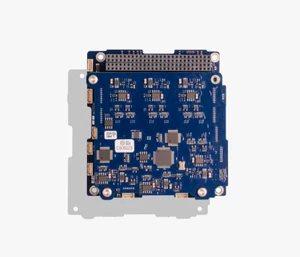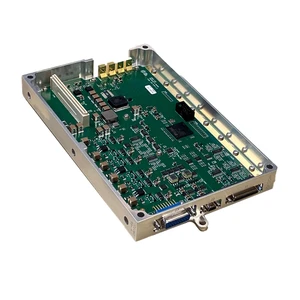
Click 'Get Pricing and Information' to add this to a request. After submission, get a response within 3 business days.
AAC Clyde Space’s SmallSat Power Conditioning and Distribution Unit (PCDU) solutions deliver proven, high-performance power control across a wide range of missions — building a global reputation for reliability, resiliency and performance.
Proven in Space
The STARBUCK-MINI continues to define industry standards for small satellite power systems, combining scalability, radiation tolerance and flight heritage in a compact form.
Now upgraded to deliver up to 2.5 kW of solar input power, the latest generation offers even greater capability for next-generation spacecraft.
Designed for Reliable Performance
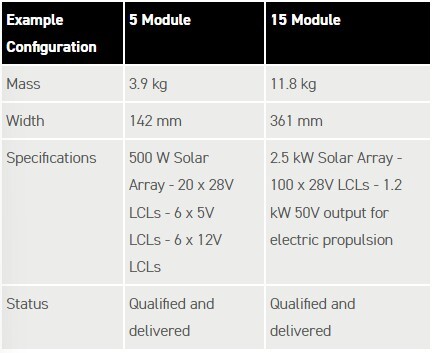
The latest STARBUCK-MINI delivers up to 2.5 kW of solar array input power — a 67% increase from previous 1.5 kW versions — enabling higher-power payloads and extended mission flexibility.
Its modular, scalable architecture allows configuration with up to 15 modules, ensuring tailored performance to meet diverse mission requirements.
Modular and Mission Adaptable
The STARBUCK-MINI adopts a modular design philosophy, allowing tailored configurations through interchangeable power, thermal, and actuator interface modules.
Additional modules can be integrated for deployment mechanisms, magnetorquers, heaters, or motor control, enabling rapid adaptation to customer specifications.
Reliability Engineered In
STARBUCK-MINI combines COTS components with radiation-hardened parts, qualified through rigorous environmental testing.
All outputs are protected by current-limiting circuits for maximum resilience, supporting redundant power paths for critical payloads.
With internal redundancies and single-point failure tolerance, STARBUCK-MINI ensures continuous operation even under the harshest on-orbit conditions.
Powering Exploration and beyond
From Lunar landers to Earth-observation missions and space-debris removal, STARBUCK-MINI continues to power spacecraft that shape the future of exploration to sustainability in orbit.
AAC Clyde Space applies the latest design and manufacturing techniques to ensure world-class quality and mission success. What began as a small-satellite innovation has become a proven, space-qualified standard — powering missions beyond Earth.
ESA is now funding ongoing development to further enhance and standardise the product for future generations.
Features:
-
- TRL 9
- Now with 2.5kW power
- EM: 6 months, FM: 10 months
- Flown 2024
- Advanced power management - with Maximum Power Point Tracking or S3R battery charge regulation
- ITAR Free
- Inbuilt protections methods (we’ve got your back!)
- Modular design, mission adaptable
| Parameter | Value |
|---|---|
| Design Life | 5-7 years in LEO |
| System Power | 2.5kW |
| Primary Bus Voltage | 22-34 V |
| Operating Temperature | -30°C to +60°C |
| Radiation Tolerance (TiD) | 20 kRAD (qualified >30 kRAD Si) |
| Dimensions | 147 x 249 x 123 mm^3 |
| Type | Document Name | Action & Size |
|---|---|---|
| No public documentation available. Please inquire for details. | ||